If You’re Towing in Eastern NC, the Numbers Matter
Eastern North Carolina is truck country for a reason. Between the farms across Pitt and Greene counties, the contractors hauling equipment through Greenville, the families pulling campers toward the Outer Banks, and the fishermen trailering boats out of Washington and Bath — a used truck around here isn’t just a vehicle. It’s a work tool.
But here’s where a lot of buyers get tripped up: they buy a truck based on how it looks or what they’ve always driven, without checking whether it can actually handle what they need to pull. Overloading a truck — even a heavy one — causes accelerated wear, brake failure risk, and in some cases, voided insurance coverage after an accident.
The good news is that understanding towing capacity isn’t complicated once someone explains it plainly. That’s what this guide is for.
The Four Numbers You Need to Know
When you’re shopping for a used truck with towing in mind, four specs define whether a truck fits your needs:
1. Tow Rating (Max Trailer Weight)
This is the number most people know — the maximum weight the truck is rated to pull behind it. A half-ton truck like a base F-150 or Silverado 1500 might be rated for 8,000–10,000 lbs depending on configuration. A three-quarter-ton or one-ton diesel can push that to 18,000–20,000+ lbs. This number assumes the truck is properly equipped and not already loaded down with gear or passengers.
2. Payload Capacity (How Much You Can Put IN the Truck)
Payload is the total weight you can put in the cab and bed combined — including passengers, tools, gravel, feed, whatever. A typical half-ton gas truck carries around 1,200–1,800 lbs of payload. A heavy-duty diesel might carry 2,500–3,500 lbs. This number matters if you’re hauling tools in the bed while also towing — both loads count against your limits.
3. GVWR (Gross Vehicle Weight Rating)
GVWR is the maximum total weight of the truck itself — including the vehicle, fuel, passengers, and everything in the bed. It’s the ceiling the manufacturer sets for safe operation. When you see a truck’s GVWR on the door jamb sticker, you’re looking at the combined limit for everything the truck carries — not counting the trailer.
4. GCWR (Gross Combined Weight Rating)
GCWR is the total maximum weight of the truck AND the trailer together. This is the number that defines your actual towing ceiling in real-world use. If your trailer weighs 9,000 lbs loaded and your truck weighs 6,000 lbs with you in it, you need a GCWR of at least 15,000 lbs — not just a tow rating of 9,000.
Half-Ton, Three-Quarter-Ton, or One-Ton: Which Do You Need?
Truck classification gets confusing fast, but for most Eastern NC buyers the choice comes down to what you’re regularly pulling.
- Half-ton trucks (F-150, Silverado 1500, Ram 1500): Best for lighter towing — small boats, single-axle utility trailers, campers under 8,000 lbs. Great all-around daily drivers that also handle weekend towing duties. Most common on the lot.
- Three-quarter-ton trucks (F-250, Silverado 2500, Ram 2500): The sweet spot for serious towing. Gas versions handle 12,000–15,000 lbs. Diesel versions push higher. Ideal for gooseneck trailers, horse trailers, heavy equipment.
- One-ton trucks (F-350, Silverado 3500, Ram 3500): Built for commercial and agricultural use. Diesel one-tons are the workhorses of farms and construction sites across Eastern NC. Maximum towing and payload ratings, but a heavier ride for daily use.
For most Greenville-area buyers who need to tow a boat to the river or pull a livestock trailer out to a property in Farmville or Snow Hill, a well-equipped half-ton handles it just fine. For contractors hauling equipment or farmers moving heavy loads regularly, the step up to a three-quarter-ton diesel is usually worth every dollar.
What Changes on Used Trucks vs. New
This is where used truck shopping gets important: the tow ratings on a truck’s door sticker reflect the original factory configuration. By the time a used truck reaches a lot, it may have been modified — lift kits, aftermarket hitches, suspension changes — all of which can affect real-world towing performance and safety. It may also have accumulated wear on brakes, transmission, and the trailer hitch receiver itself.
Before you commit to a used truck for towing, ask about:
- Whether the truck has the factory tow package (wiring harness, transmission cooler, upgraded radiator)
- The condition of the brake controller wiring if you’re pulling trailers with electric brakes
- Any aftermarket modifications to the suspension or hitch
- Transmission service history — towing is hard on transmissions, and a truck that’s been pulling regularly without proper fluid changes shows it over time
Common Loads in Eastern NC and What Truck You Need
Here’s a quick reference based on what we see buyers towing across the Greenville area:
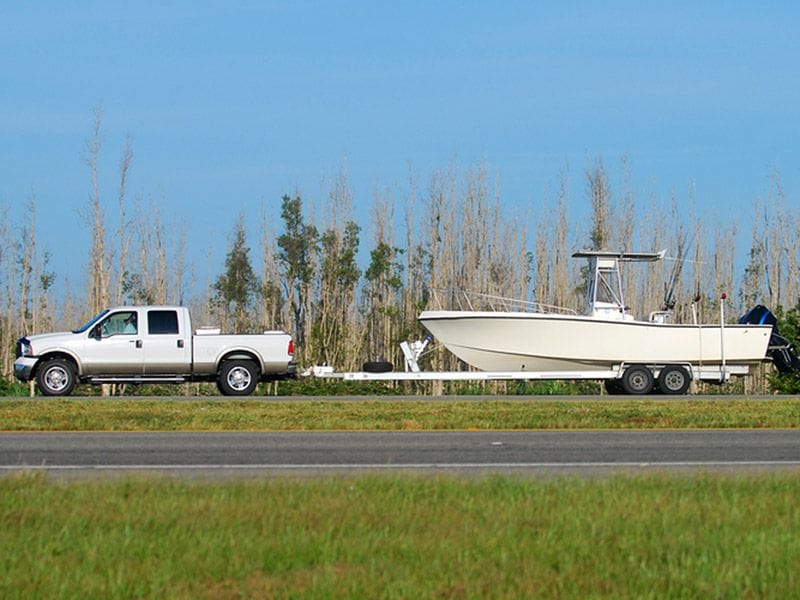
- Bass boat or bay boat on a single-axle trailer (3,000–5,000 lbs loaded): Any half-ton handles this comfortably
- 20–25 ft travel trailer or fifth wheel (7,000–12,000 lbs): Half-ton with max tow package or three-quarter-ton gas
- Flatbed trailer with skid steer or tractor implement (10,000–16,000 lbs): Three-quarter-ton diesel is the right call
- Livestock trailer or gooseneck with cattle (15,000–20,000+ lbs): One-ton diesel, no compromises
- Utility trailer for landscaping or construction debris (3,000–6,000 lbs): Any properly equipped half-ton
Find the Right Used Truck for Your Haul at Bells Fork
At Bells Fork Truck & Auto, located at 3840 Charles Blvd in Greenville, NC, we carry used trucks across the full range of tow capability — from capable half-tons ready for weekend boat duty to heavy-duty diesel trucks built for serious farm and construction work.
When you come to the lot, tell us what you need to pull. We’ll point you to trucks that are properly equipped and can actually handle the job — not just something that looks like it can. Every vehicle we sell goes through a multi-point inspection, and we’ll be straight with you about a truck’s tow history and service records.
Browse our current inventory at BellsForkTruckAndAuto.com or stop by the lot on Charles Blvd. We’re local, we know Eastern NC roads, and we know what it takes to work and haul in this part of the state.