The Question Comes Up on Almost Every Truck Sale
Eastern North Carolina is flat. It rarely snows. Most roads around Greenville are paved and well maintained. So a reasonable person might ask: why does it feel like every truck on every lot around here is a 4x4?
It’s a fair question, and the answer isn’t simply that four-wheel drive is always better. Four-wheel drive costs more to buy, more to maintain, and it burns more fuel. For some buyers around here it’s essential. For others it’s money spent on capability that never gets used.
Here’s how to figure out which one you are.
First, the Terminology
2WD (Two-Wheel Drive)
Power goes to two wheels. On trucks this is almost always rear-wheel drive — sometimes written as 4x2. Simpler, lighter, cheaper, better fuel economy, fewer components to fail.
4WD (Four-Wheel Drive)
Power can be sent to all four wheels, typically engaged manually by the driver via a switch or lever. Most truck 4WD systems are part-time, meaning they are not designed to be used on dry pavement. Includes low range (4LO) for serious low-speed traction situations.
AWD (All-Wheel Drive)
Power is distributed automatically without driver input, and it can be used on dry pavement. More common on SUVs and crossovers than on pickups. Better for on-road wet-weather traction, but generally not built for the low-speed, high-torque situations 4LO handles.
⚠️ Common mistake: Part-time 4WD should not be engaged on dry pavement. It causes drivetrain binding and can damage components. If you buy a 4x4, learn when to engage it — and when not to.
When 4x4 Genuinely Earns Its Keep in Eastern NC
Despite the flat terrain, there are real and common situations around here where four-wheel drive matters:
• Farm and field work: Pitt, Greene, and Lenoir county farmland turns to mud after rain. Getting across a soft field with a load in the bed is exactly what 4WD exists for.
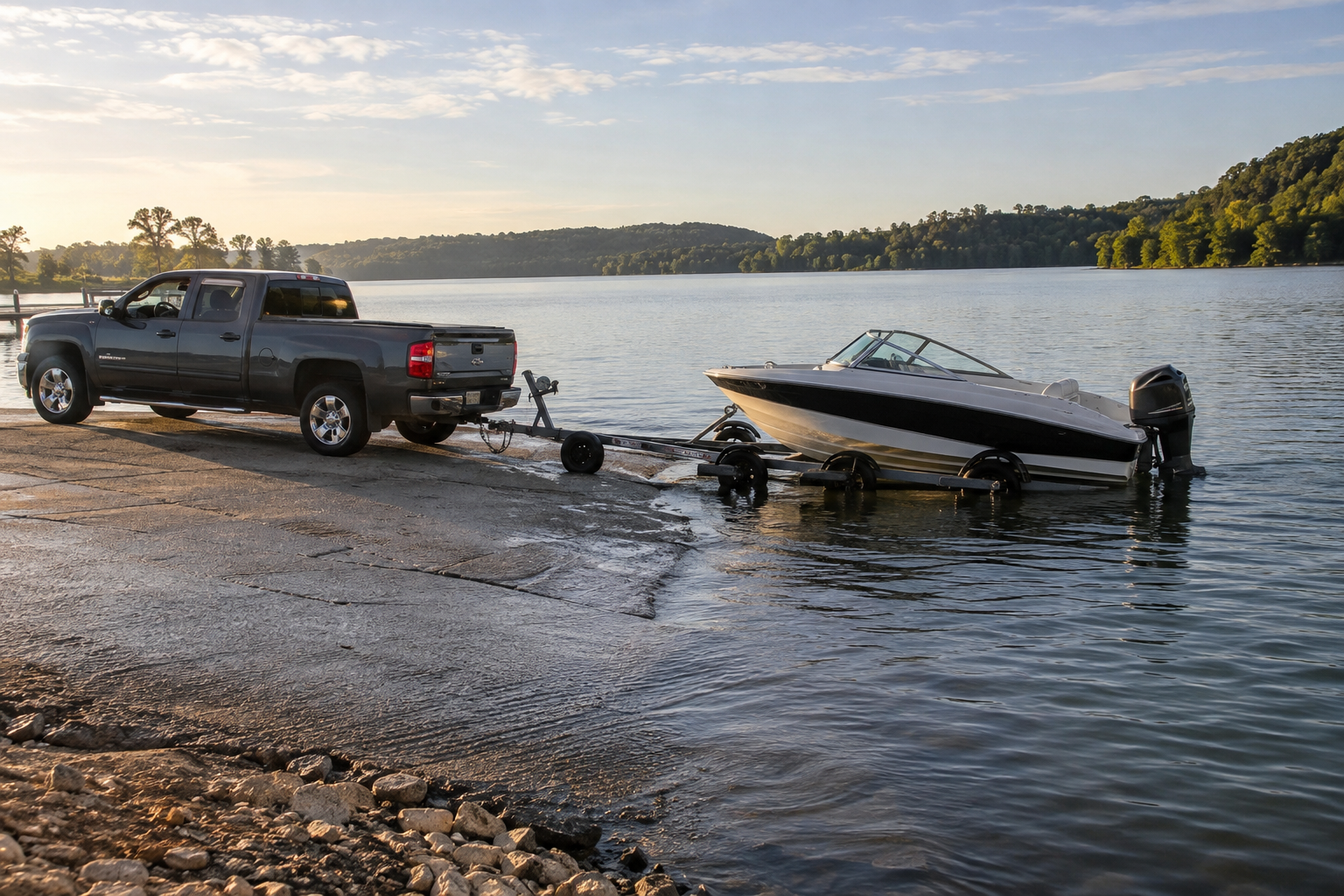
• Boat ramps: Wet, algae-covered concrete ramps are one of the most common places 2WD trucks lose traction in Eastern NC — especially pulling a loaded trailer back up. Anyone regularly launching on the Tar, the Pamlico, or at coastal ramps should take this seriously.
• Beach driving: If you drive on the sand at the Outer Banks, Carova, or anywhere requiring a beach permit, 4WD is typically required, not optional.
• Construction and job sites: Unfinished sites, graded lots, and dirt access roads get soft fast after Eastern NC rain.
• Hunting and rural land access: Dirt tracks, timber roads, and field edges.
• Towing on unpaved or uneven surfaces: The added traction matters more with weight behind you.
• Hurricane and storm aftermath: Debris, mud, and washed-out shoulders — though this is never a reason to attempt driving through floodwater.
When 2WD Is the Smarter Buy
A rear-wheel-drive truck is genuinely the better financial choice for a lot of Eastern NC buyers:
• Daily commuting on paved roads around Greenville, Winterville, or Ayden
• Hauling on paved surfaces — dump runs, lumber yard trips, equipment on hard ground
• Highway-heavy driving where fuel economy matters more than traction
• Buyers on a tighter budget who’d rather put the savings into a better-maintained or lower-mileage truck
A 2WD truck typically costs noticeably less to buy, gets modestly better fuel economy, weighs less (which can mean slightly higher payload capacity), and has fewer expensive components that can fail — no transfer case, no front differential, no front axle shafts or CV components.
The Cost Difference, Honestly
Purchase Price
Comparable used trucks typically carry a meaningful premium for 4WD — often in the range of a couple thousand dollars depending on year, mileage, and configuration. On a used lot, that gap is real money you could apply toward a better-condition truck instead.
Fuel
Four-wheel drive adds weight and drivetrain drag. Expect a modest fuel economy penalty — generally a mile or two per gallon. Over high annual mileage, that adds up.
Maintenance and Repair
More components means more that can eventually need service: transfer case fluid, front differential fluid, front axle seals, actuators, and the four-wheel-drive engagement system itself. None of this is exotic, but it’s real ongoing cost that a 2WD truck simply doesn’t have.
Insurance
Typically a small difference, driven mostly by the higher vehicle value rather than the drivetrain itself.
The Resale Argument — And Why It Cuts Both Ways
Here’s the counterpoint to everything above: 4x4 trucks hold their value better and sell faster in this market.
Eastern NC has a deep pool of buyers who genuinely need four-wheel drive — farmers, contractors, hunters, boaters. That demand means a 4x4 truck generally has more potential buyers when you go to sell it, and it tends to sit on the market for less time.
So the calculation isn’t just “do I need it today.” It’s also “what happens when I sell it.” If you buy a 2WD truck at a discount and sell it at a discount, the premium you avoided partially comes back out of your pocket on the other end. For buyers who keep vehicles a long time, this matters less. For buyers who turn over vehicles every few years, it matters more.
📊 The practical read: If the price gap between a comparable 4x4 and 2WD is modest and you might ever need the traction, 4x4 is usually the safer long-term call in this region. If the gap is wide and you drive exclusively on pavement, take the 2WD and the savings.
What to Check on a Used 4x4 Before You Buy
A four-wheel-drive system that doesn’t work is worse than not having one — you paid for it and can’t use it. On any used 4x4, verify:
☐ Engage 4HI during the test drive and confirm it actually engages — dash indicator lights up and you can feel the difference
☐ Engage 4LO (typically requires stopping and shifting to neutral) and confirm it works
☐ Listen for grinding, clunking, or binding when engaged
☐ Check for leaks around the transfer case and front differential
☐ Look at the front axle boots and CV joints for cracks or torn rubber
☐ Ask whether transfer case and front differential fluids have ever been serviced
☐ Confirm the 4WD actuator engages promptly rather than hesitating
A surprising number of used 4x4 trucks have systems that haven’t been engaged in years. Components seize when they sit unused. Always test it before you buy — not after.
Come Drive Both and See for Yourself
At Bells Fork Truck & Auto, located at 3840 Charles Blvd in Greenville, NC, we carry both 2WD and 4x4 trucks because different buyers around here genuinely need different things.
Tell us what you actually do with a truck — where you drive, what you haul, whether you’re on fields or ramps or just pavement — and we’ll point you honestly toward what fits. If 2WD is the right call for you, we’ll say so, even though the 4x4 on the lot costs more.
Browse our current inventory at BellsForkTruckAndAuto.com or stop by the lot on Charles Blvd. Every truck we sell carries a clean title and goes through a multi-point inspection — including the four-wheel-drive system.